
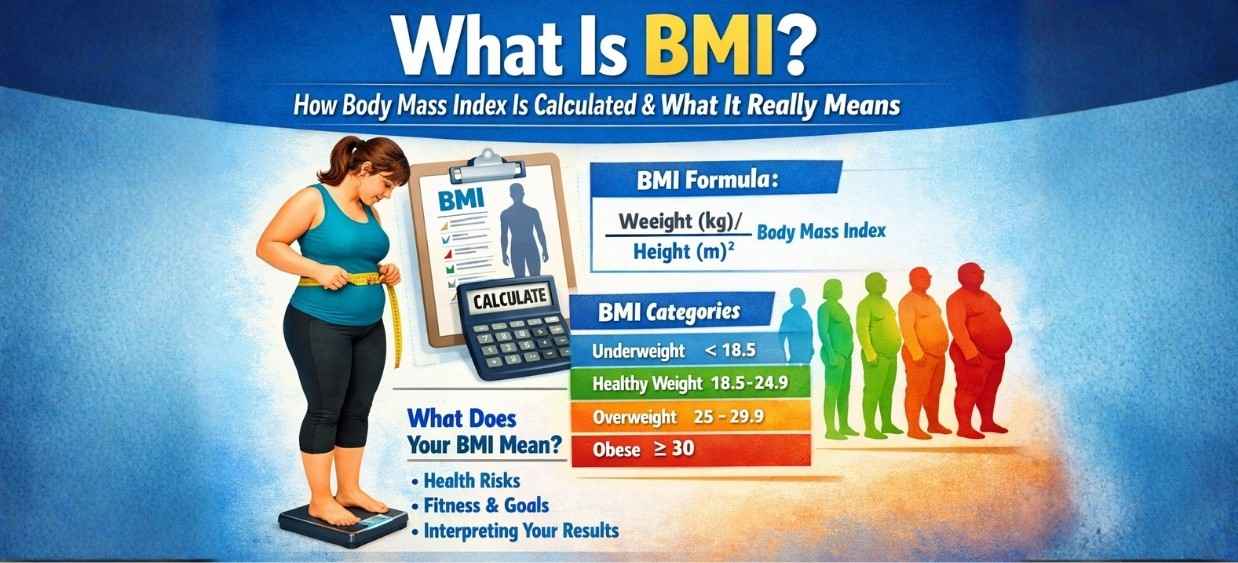
Many people ask what is BMI and whether it truly reflects health. BMI, short for Body Mass Index, is a commonly used measurement to assess whether a person has a healthy body weight for their height. Doctors, fitness experts, and health organizations worldwide use BMI as a simple screening tool—but it’s not a perfect measure.
This article explains what BMI is, how it’s calculated, BMI ranges, and what it really means for your health.
What Is BMI?
Body Mass Index (BMI) is a numerical value derived from a person’s height and weight. It helps categorize individuals as underweight, normal weight, overweight, or obese.
BMI does not directly measure body fat, but it gives a general idea of weight-related health risks.
Why BMI Is Used
BMI is widely used because it is:
- Simple and quick to calculate
- Cost-free
- Useful for large populations
- Helpful in identifying potential health risks
Healthcare professionals often use BMI as a screening tool, not a diagnostic test.
How Body Mass Index Is Calculated
BMI Formula
BMI=Weight (kg)Height (m)2BMI = \frac{Weight\ (kg)}{Height\ (m)^2}BMI=Height (m)2Weight (kg)
Example:
If a person weighs 70 kg and is 1.75 m tall: BMI=70÷(1.75×1.75)=22.9BMI = 70 ÷ (1.75 × 1.75) = 22.9BMI=70÷(1.75×1.75)=22.9
A BMI of 22.9 falls within the normal weight range.
BMI Categories and Ranges
| BMI Value | Category |
|---|---|
| Below 18.5 | Underweight |
| 18.5 – 24.9 | Normal weight |
| 25 – 29.9 | Overweight |
| 30 – 34.9 | Obesity Class I |
| 35 – 39.9 | Obesity Class II |
| 40+ | Obesity Class III |
These ranges apply to most adults aged 18 and above.
What BMI Really Means for Your Health
BMI helps estimate health risk, not overall fitness.
Health Risks Linked to High BMI
- Heart disease
- Type 2 diabetes
- High blood pressure
- Joint problems
- Sleep apnea
Risks of Low BMI
- Nutrient deficiencies
- Weak immunity
- Bone loss
- Fatigue
BMI acts as an early warning sign, not a final diagnosis.
Limitations of BMI
While useful, BMI has several limitations.
1. BMI Does Not Measure Body Fat
Muscle weighs more than fat. Athletes may have a high BMI but low body fat.
2. BMI Ignores Fat Distribution
BMI doesn’t show where fat is stored. Belly fat carries higher health risks.
3. BMI Varies by Age and Gender
Older adults and women may have different healthy body fat levels.
Is BMI Accurate for Everyone?
BMI may be less accurate for:
- Athletes
- Bodybuilders
- Pregnant women
- Elderly individuals
In such cases, BMI should be combined with:
- Waist circumference
- Body fat percentage
- Lifestyle and activity level
- Medical history
BMI vs Body Fat Percentage
| BMI | Body Fat % |
|---|---|
| Weight-based | Fat-based |
| Simple | More accurate |
| No equipment | Needs tools |
| Screening tool | Health assessment |
BMI is a starting point, while body fat percentage offers deeper insight.
How to Improve BMI Naturally
Healthy Tips
- Eat a balanced, whole-food diet
- Stay physically active
- Improve sleep quality
- Manage stress
- Stay hydrated
Healthy lifestyle changes improve both BMI and overall health.
Final Thoughts: What Is BMI Really Telling You?
Understanding what is BMI helps you interpret your weight in relation to health—but it should never be the only measure. BMI is best used as a guideline, not a judgment.
For accurate health assessment, always combine BMI with other indicators like body composition, fitness level, and medical advice.