
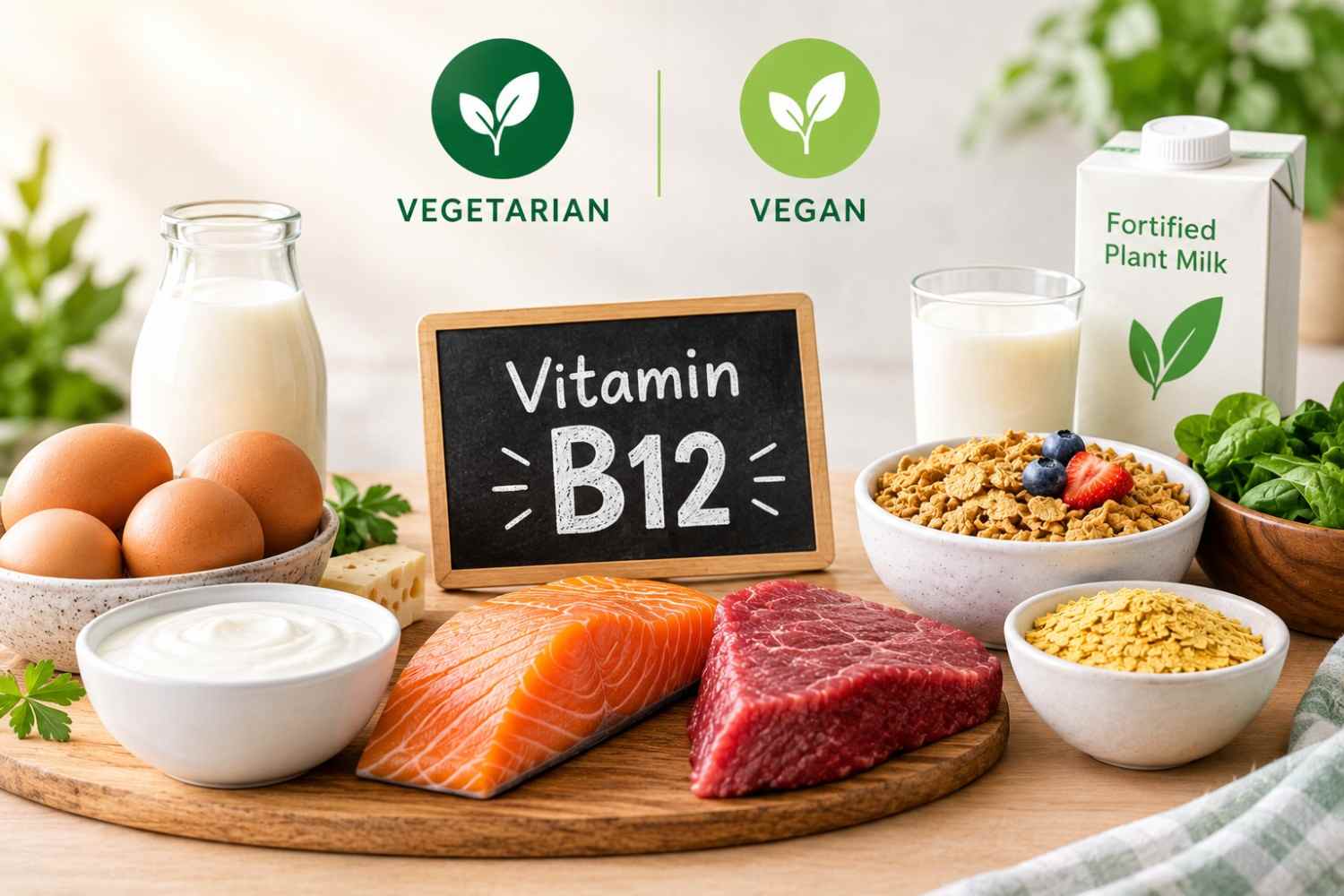
A vegetarian or vegan diet can include a wide variety of nutritious foods, but some vitamins need special attention. Vitamin B12 is one of them.
Vitamin B12 is important for healthy red blood cells, normal nerve function and DNA production. The challenge for people following plant-based diets is that vitamin B12 occurs naturally mainly in animal-derived foods. Ordinary fruits, vegetables, grains, beans, nuts and seeds are not reliable natural sources of B12.
This does not mean you cannot maintain healthy B12 levels while eating a vegetarian or vegan diet. With proper planning, vegetarians can obtain B12 from dairy, eggs and fortified foods, while vegans can use fortified foods and appropriate supplements.
In this guide, we explain how vegetarians and vegans can get enough vitamin B12, which foods to look for, how to read food labels and when supplementation may be useful.
- Why Is Vitamin B12 Important?
- Why Is Vitamin B12 a Concern on a Vegan Diet?
- Do Vegetarians Need Vitamin B12?
- Best Vitamin B12 Sources for Vegetarians
- Best Vitamin B12 Sources for Vegans
- How Much Vitamin B12 Do You Need?
- Can a Vegan Get Enough B12 Without Taking Supplements?
- How to Check Vitamin B12 on Food Labels
- Are Plant Foods Naturally High in Vitamin B12?
- What About Spirulina and Seaweed?
- Vitamin B12 Supplements for Vegans
- Does a High-Dose B12 Supplement Mean You Are Taking Too Much?
- Signs That You May Have a Vitamin B12 Problem
- Vitamin B12 During Pregnancy and Breastfeeding
- A Simple Vegetarian B12 Meal Pattern
- A Simple Vegan B12 Meal Pattern
- Vegetarian vs Vegan Vitamin B12 Sources
- Common B12 Mistakes on Plant-Based Diets
- How to Build a Reliable B12 Routine
- Frequently Asked Questions
- Final Thoughts
Why Is Vitamin B12 Important?
Vitamin B12 performs several essential functions in the body.
It helps with:
- Healthy red blood cell formation
- Normal nervous system function
- DNA production
- Normal cellular metabolism
- Prevention of megaloblastic anemia caused by B12 deficiency
The body can store substantial amounts of vitamin B12, so deficiency may take a long time to become noticeable. However, delaying treatment after deficiency develops can allow neurological problems to become more serious.
For this reason, people who avoid most or all animal products should think about B12 before symptoms appear.
Why Is Vitamin B12 a Concern on a Vegan Diet?
The main issue is not that vegan diets are unhealthy. The issue is that natural dietary B12 sources are limited.
According to the NIH, vitamin B12 occurs naturally in animal foods, while plant foods contain B12 mainly when it has been added through fortification. Fortified breakfast cereals and nutritional yeast are examples of plant-based foods that can provide B12.
Therefore, eating plenty of vegetables, fruits, lentils, beans and whole grains does not automatically provide enough B12.
A vegan diet needs a deliberate B12 strategy.
Do Vegetarians Need Vitamin B12?
It depends on the type of vegetarian diet.
A person who regularly eats:
- Milk
- Yogurt
- Cheese
- Eggs
has more opportunities to obtain B12 than someone who avoids all animal-derived foods.
However, simply identifying as vegetarian does not guarantee adequate B12 intake. Someone who eats dairy or eggs only occasionally may still need fortified foods or supplements.
The NHS recommends that vegetarians who consume only small amounts of eggs or dairy, or avoid them completely, make sure they have a reliable B12 source.
Best Vitamin B12 Sources for Vegetarians
1. Milk
Milk naturally contains vitamin B12 and can contribute to daily intake.
It can be included with:
- Breakfast cereals
- Oatmeal
- Smoothies
- Tea or coffee
- Other meals
If you switch from dairy milk to plant milk, check whether the replacement is fortified with B12.
2. Yogurt
Yogurt is another convenient source of B12 for people who consume dairy.
It can be added to breakfast, snacks, smoothies or meals.
3. Cheese
Cheese contains B12, although the amount varies by type and serving size.
It can be used in sandwiches, salads, wraps and cooked meals.
4. Eggs
Eggs provide vitamin B12 and can be useful in a vegetarian diet.
However, if you eat eggs only occasionally, they should not necessarily be your only B12 strategy.
5. Fortified Foods
Fortified breakfast cereals, fortified plant products and fortified yeast products can provide additional B12.
Always check the label because the amount of added B12 varies between products.
Best Vitamin B12 Sources for Vegans
Vegans have fewer natural dietary options, so fortified foods and supplements become particularly important.
Fortified Plant Milk
Some soy, oat, almond and other plant-based drinks contain added vitamin B12.
However, not every plant milk is fortified.
When shopping, check the nutrition label for vitamin B12 and the amount provided per serving.
Fortified Breakfast Cereals
Some breakfast cereals contain added B12.
A bowl of fortified cereal with fortified plant milk can be a convenient way to include B12 in a vegan breakfast.
But always check the nutritional information rather than assuming a cereal contains B12.
Fortified Nutritional Yeast
Nutritional yeast is commonly used in vegan cooking because of its savory flavor.
Some brands are fortified with vitamin B12 and can be added to:
- Pasta
- Rice
- Soups
- Popcorn
- Vegetables
- Salads
- Vegan sauces
Not all nutritional yeast contains B12, so the label matters.
Other Fortified Plant-Based Foods
Some meat alternatives, dairy alternatives and other plant-based foods may contain added vitamin B12.
Fortification can vary considerably from one product to another.
How Much Vitamin B12 Do You Need?
The NIH lists the following recommended amounts:
| Life Stage | Recommended B12 |
|---|---|
| Adults 19+ | 2.4 mcg/day |
| Pregnancy | 2.6 mcg/day |
| Breastfeeding | 2.8 mcg/day |
| Teenagers 14–18 | 2.4 mcg/day |
| Children 9–13 | 1.8 mcg/day |
These are general recommended dietary amounts. They should not automatically be interpreted as a supplement dose.
People with diagnosed deficiency or absorption problems may require a different treatment plan.
Can a Vegan Get Enough B12 Without Taking Supplements?
Yes, if the diet consistently includes adequate fortified foods.
However, a vegan diet based entirely on unfortified plant foods is not a dependable way to obtain B12.
The NHS recommends that people following vegan diets include fortified foods or consider supplements for nutrients that can be difficult to obtain, including vitamin B12.
For some people, a supplement is simply the easiest way to establish a reliable routine.
The important thing is not whether B12 comes from a particular product. The important thing is having a consistent and dependable source.
How to Check Vitamin B12 on Food Labels
If you are vegetarian or vegan, food labels can become one of your most useful tools.
Look for:
Vitamin B12
You may also see names such as:
- Cyanocobalamin
- Methylcobalamin
Check both:
- The amount of B12 per serving
- The serving size
For example, a product may contain B12 but only provide a small amount per serving.
Also check the label every time you buy a new product because manufacturers can change their formulations.
The NIH specifically recommends checking nutrition labels for added vitamin B12 in fortified foods.
Are Plant Foods Naturally High in Vitamin B12?
Generally, no.
Foods such as:
- Spinach
- Broccoli
- Bananas
- Apples
- Lentils
- Chickpeas
- Kidney beans
- Rice
- Whole grains
- Almonds
- Chia seeds
can be nutritious parts of a vegetarian or vegan diet, but they should not be counted as reliable natural B12 sources.
Vitamin B12 is naturally found in animal foods. Plant-based foods can provide B12 when manufacturers add it through fortification.
What About Spirulina and Seaweed?
Online articles sometimes describe spirulina, algae, seaweed or fermented foods as natural B12 sources.
This can be confusing.
These products should not be treated as dependable substitutes for established B12 sources. Some algae products may contain B12-like compounds rather than providing a reliable amount of biologically useful B12.
For people following vegan diets, fortified foods and appropriate B12 supplements are more dependable strategies.
Vitamin B12 Supplements for Vegans
A B12 supplement can be a practical option for people who do not regularly consume enough fortified foods.
The appropriate supplement and schedule can vary depending on factors such as:
- Age
- Diet
- Existing B12 levels
- Absorption
- Medical conditions
- Pregnancy or breastfeeding
- Medications
Some people with dietary deficiency may be treated with oral B12, while others with absorption problems may require medical treatment such as injections.
If you have been diagnosed with B12 deficiency, do not assume that a standard over-the-counter supplement is sufficient. Follow the treatment plan recommended by your healthcare professional.
Does a High-Dose B12 Supplement Mean You Are Taking Too Much?
B12 supplements can contain amounts much higher than the daily recommended intake.
For example, the NIH notes that a 500 mcg B12 supplement provides a very large percentage of the Daily Value. This is possible because the body absorbs only a portion of large supplemental doses.
A high number on the supplement label therefore does not automatically mean the supplement is inappropriate.
However, it is still sensible to choose supplements based on your actual needs rather than assuming that the highest dose is always best.
If you have a medical condition, take medications or have been diagnosed with deficiency, discuss supplementation with a healthcare professional.
Signs That You May Have a Vitamin B12 Problem
B12 deficiency can develop slowly.
Possible signs include:
- Unusual tiredness
- Weakness
- Pale skin
- Numbness
- Tingling sensations
- Balance problems
- Memory changes
- Difficulty concentrating
- A sore or swollen tongue
- Anemia
These symptoms can also occur for many other reasons.
If you follow a vegetarian or vegan diet and develop persistent symptoms, speak with a healthcare professional rather than assuming that B12 is definitely the cause.
A blood test may be used as part of the evaluation.
For a detailed explanation of symptoms, readers can also explore Vitamin B12 Deficiency: Signs and Symptoms on HealthDiary24.
Vitamin B12 During Pregnancy and Breastfeeding
B12 deserves additional attention during pregnancy and breastfeeding.
The NIH recommends 2.6 mcg per day during pregnancy and 2.8 mcg per day during breastfeeding.
A pregnant or breastfeeding person following a strict vegan diet should make sure their B12 intake is reliable.
This is particularly important because infants who are exclusively breastfed by mothers with inadequate B12 status can also become deficient. Severe deficiency in infants can have serious consequences.
If you are pregnant, planning pregnancy or breastfeeding while following a vegetarian or vegan diet, discuss your nutritional plan with your doctor or registered dietitian.
A Simple Vegetarian B12 Meal Pattern
A vegetarian day could include:
Breakfast
Fortified cereal with milk or fortified plant milk.
Lunch
Vegetable sandwich with cheese and a side of yogurt.
Snack
Boiled egg with fruit.
Dinner
Vegetable pasta with cheese and yogurt-based dressing.
The exact B12 intake depends on the products and serving sizes.
A Simple Vegan B12 Meal Pattern
A vegan day could include:
Breakfast
Fortified breakfast cereal with B12-fortified soy or oat milk.
Lunch
Lentil or chickpea bowl with vegetables and fortified nutritional yeast.
Snack
A fortified plant-based yogurt.
Dinner
Tofu, beans or another plant protein with vegetables and rice.
A suitable B12 supplement can also be incorporated into the person’s nutrition routine when needed.
Vegetarian vs Vegan Vitamin B12 Sources
| B12 Source | Vegetarian | Vegan |
|---|---|---|
| Milk | ✓ | ✗ |
| Yogurt | ✓ | ✗ |
| Cheese | ✓ | ✗ |
| Eggs | ✓ | ✗ |
| Fortified plant milk | ✓ | ✓ |
| Fortified cereal | ✓ | ✓ |
| Fortified nutritional yeast | ✓ | ✓ |
| B12 supplement | May be useful | Often useful |
| Meat and fish | ✗ | ✗ |
Remember that fortified products differ, so always check the nutrition label.
Common B12 Mistakes on Plant-Based Diets
Mistake 1: Assuming a Healthy Diet Automatically Contains B12
A diet can be rich in vegetables, fruit, legumes and whole grains and still be low in B12.
Mistake 2: Assuming All Vegan Products Are Fortified
“Vegan” describes what a product does not contain. It does not automatically mean that vitamin B12 has been added.
Mistake 3: Relying on One Fortified Food Without Checking the Label
Fortification levels can differ between brands and products.
Mistake 4: Waiting for Symptoms
B12 deficiency can take time to develop, so relying on symptoms alone is not a good nutritional strategy.
Mistake 5: Choosing Supplements Without Considering Individual Needs
A person with dietary insufficiency and someone with an absorption disorder may require different approaches.
How to Build a Reliable B12 Routine
If you are vegetarian or vegan, use these simple steps:
Step 1: Identify Your Diet
Determine whether you regularly eat dairy, eggs or neither.
Step 2: Find Reliable B12 Sources
Choose suitable dairy and eggs if vegetarian, or fortified foods and supplements if vegan.
Step 3: Read Labels
Check the amount of B12 rather than assuming a product contains it.
Step 4: Be Consistent
A reliable routine is more useful than occasionally eating a fortified product.
Step 5: Review Your Needs When Your Diet Changes
If you move from vegetarian to vegan, for example, your B12 strategy may need to change.
Step 6: Seek Professional Advice When Necessary
This is especially important during pregnancy, breastfeeding, illness or confirmed deficiency.
Frequently Asked Questions
What is the best vitamin B12 source for vegans?
Fortified foods such as B12-fortified nutritional yeast, breakfast cereals and plant milks can provide B12. A suitable supplement can also be a reliable option.
Can vegans get B12 from vegetables?
Ordinary vegetables are not reliable natural sources of vitamin B12. Vegan diets generally need fortified foods or supplements to provide dependable B12.
Do vegetarians need B12 supplements?
Not necessarily. Some vegetarians may obtain sufficient B12 from regular dairy, eggs and fortified foods. People who consume very little of these foods may need another reliable source.
Is nutritional yeast always high in B12?
No. Only nutritional yeast that has been fortified with B12 should be counted as a dependable B12 food source. Check the label.
Is plant milk a source of B12?
Some plant milks are fortified with B12, but others are not. Always check the nutrition information.
Can B12 deficiency happen without anemia?
Yes. Neurological symptoms can occur with B12 deficiency even when anemia is not obvious.
How long does it take for B12 deficiency to develop?
The body stores a substantial amount of B12, so deficiency may take years to become noticeable in some people. This does not mean that a long period without B12 is safe.
Final Thoughts
Following a vegetarian or vegan diet does not mean you have to miss out on vitamin B12. The key is to understand the difference between naturally occurring B12 and fortified B12.
Vegetarians may obtain B12 from milk, yogurt, cheese and eggs, while vegans generally need dependable fortified foods and/or supplements.
Rather than relying on occasional foods or online claims about plant-based B12 sources, create a simple routine that works with your diet. Check food labels, choose reliable fortified products and speak with a healthcare professional if you have symptoms, risk factors or concerns about your B12 status.